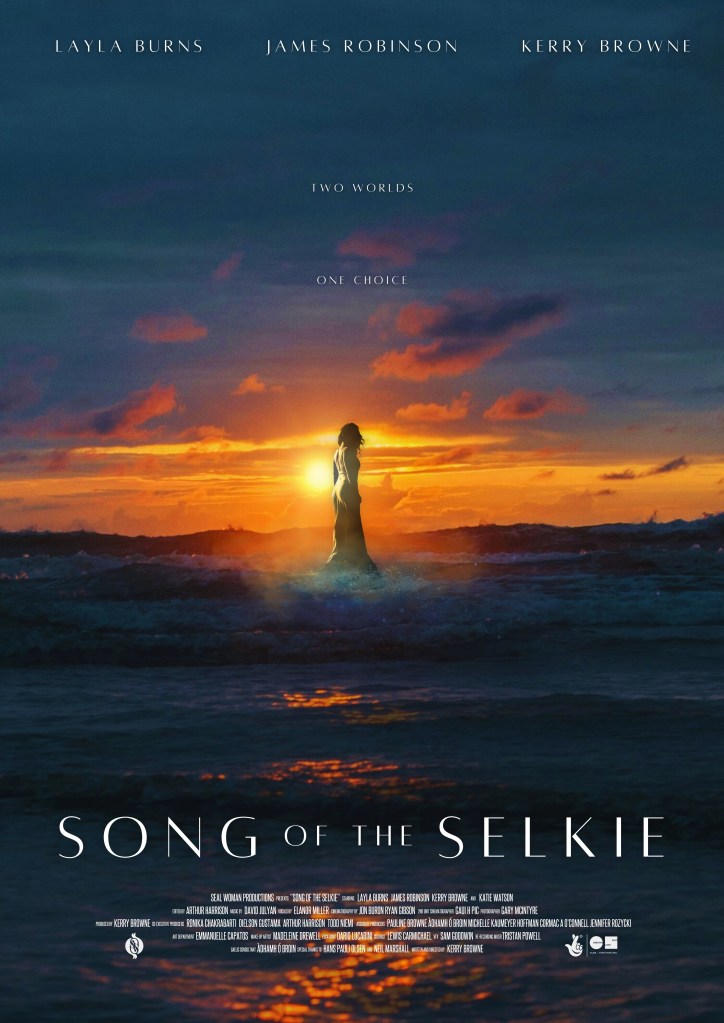
Kerry Browne’s The Song of the Selkie is the kind of film that feels less like a narrative you watch and more like a memory you stumble upon—half dream, half folklore, carried on the wind and tide of the Scottish Highlands. In a cinematic landscape often driven by spectacle and speed, Browne’s lyrical short instead leans into patience and emotional resonance, trusting the audience to listen carefully to the whispers between land and sea.
Set across two time periods and woven with both English and Scots Gaelic dialogue, The Song of the Selkie follows Isla, a young girl who returns to the Highlands with her father. What begins as a simple journey home gradually unfolds into something more mystical, guiding Isla—and the viewer —toward the ancient legend of the Selkie, a mythical being said to live as a seal in the sea but shed its skin to walk as a human on land. Browne uses this myth not merely as folklore but as an emotional framework through which the film explores love, loss, identity, and belonging.
At its heart, The Song of the Selkie is a love story—though not in the traditional sense. It is a love story between a husband and wife shaped by secrets and sacrifice, between a mother and daughter separated by circumstance yet bound by something deeper than time, and perhaps most poignantly, between humanity and the natural world. The sea in Browne’s film is not just a setting; it is a living presence, breathing alongside the characters, echoing their sorrow and longing.
The film’s greatest strength lies in its subtlety. Browne does not hand the audience its meaning outright; instead, she invites viewers to discover it. Small gestures, lingering glances, and quiet pauses carry the emotional weight of the story. These nuances are where the film’s brilliance resides. Every frame seems to hold a secret waiting to be felt rather than explained.
Watching The Song of the Selkie requires a kind of emotional attentiveness rarely demanded by contemporary storytelling. It is a film that asks its audience to engage with heart and soul—to lean into the quiet spaces and allow the atmosphere to speak. Those who accept that invitation will
find a deeply rewarding experience, one that slowly reveals itself like a tide pulling back from the shore.
The performances are grounded and sincere, lending authenticity to a story that dances between reality and myth. The actors avoid melodrama,
instead embodying their characters with a restrained emotional depth that allows the film’s themes to resonate organically. Isla’s journey in particular becomes the emotional anchor of the film, her curiosity and vulnerability guiding us through both the literal and spiritual landscapes of the story.
Visually, Browne’s film is stunning in a way that feels both intimate and expansive. The cinematography captures the Scottish Highlands with a reverence that borders on poetic. The rolling distant hills, waves breaking against darkened shores, and the quiet coast are framed with painterly precision. Yet the visuals never feel like mere postcard beauty; they are essential to the narrative, reinforcing the film’s meditation on nature, myth, and memory.
Equally powerful is the film’s music score, which moves through the story like a haunting melody carried across water. The score does not overwhelm the film but rather breathes with it, amplifying its emotional undercurrents. Combined with the natural soundscape of wind, sea, and silence, the music deepens the film’s immersive atmosphere.
What makes The Song of the Selkie particularly compelling is the way its artistic elements—acting, cinematography, and music—work in quiet synergy. None of these components competes for attention; instead, they blend seamlessly to create a cohesive and emotionally rich experience. It is a reminder that cinema, at its best, is a collaborative art form where each element strengthens the others.
By the time the film reaches its closing moments, The Song of the Selkie leaves behind a lingering emotional echo, much like the myths that inspired it. It is beautiful, melancholic, and deeply human. Browne has crafted a story that honors both folklore and feeling, reminding us that some legends endure not because they are fantastical, but because they reflect truths we recognize within ourselves.
Simply put, The Song of the Selkie is a film that stays with you. Quietly powerful and delicately told, it is a testament to the magic that can happen when storytelling trusts in subtlety, atmosphere, and the timeless pull of myth. And for those willing to listen carefully, its song is unforgettable.
 Bond on Cinema with Ward W. Bond
Leave a comment