Nayla Al Khaja’s BAAB emerges as a strikingly assured foray into psychological dark fantasy, anchoring its supernatural conceit in the raw, unvarnished terrain of grief. Framed through the fractured psyche of a woman grappling with the sudden loss of her twin sister, the film navigates an emotional labyrinth where memory, identity, and mourning collapse into one another with unsettling precision.

From the outset, BAAB establishes an atmosphere of quiet dread. The persistent, almost invasive hum of tinnitus in the protagonist’s ear becomes more than a sensory affliction; it functions as a narrative device, a sonic gateway pulling her—and the audience—into an increasingly surreal interior world. Al Khaja deftly externalizes grief, rendering it tactile and inescapable as the protagonist spirals through three distinct emotional states: depression, anger, and bargaining. Each phase is visually and tonally distinct, yet seamlessly interwoven, giving the film a rhythmic, almost hypnotic progression.
Set against an isolated Emirati landscape that feels both timeless and otherworldly, the film draws heavily from regional myth and cultural memory. This backdrop is not merely aesthetic but thematic, reinforcing the story’s meditation on loss and the unseen forces that bind the living to the dead. The titular “doorway” becomes a potent symbol—at once a passage toward healing and a threshold into something far more ambiguous, even menacing.

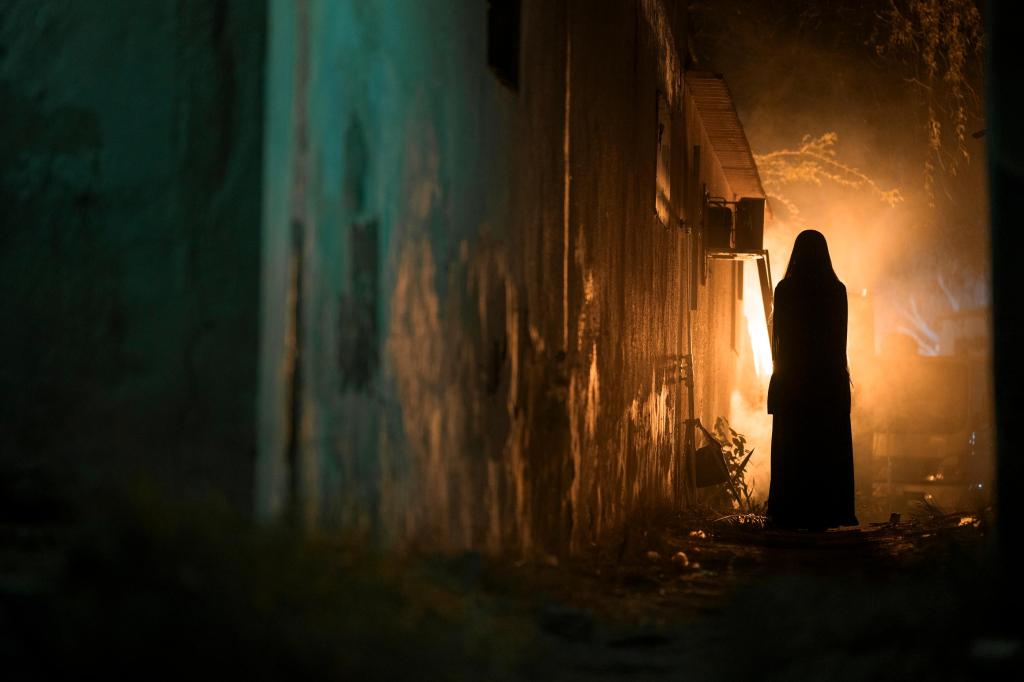
Visually, BAAB is nothing short of arresting. The cinematography leans into surrealism without sacrificing emotional clarity, employing stark contrasts, fluid camera movements, and evocative compositions that mirror the protagonist’s inner disarray. Light and shadow play a crucial role, often obscuring as much as they reveal, inviting viewers to question what is real and what is imagined.
Performance-wise, the cast delivers across the board. The lead, in particular, shoulders the film’s emotional weight with remarkable restraint and intensity, capturing the disorienting push and pull of grief without veering into melodrama. Supporting performances are equally committed, grounding the film’s more fantastical elements in human authenticity.
What begins as an intimate psychological study gradually expands into something more metaphysical, suggesting that grief is not a linear journey but a porous boundary between worlds. In that sense, BAAB resonates beyond its narrative, offering a contemplative, if unsettling, reflection on loss, identity, and the enduring bond between twins.
In a regional industry still finding its global voice, BAAB stands out as one of the most compelling films to emerge from the UAE in recent years—bold, visually ambitious, and emotionally resonant.
 Bond on Cinema with Ward W. Bond
Leave a comment